

Have you ever found yourself staring at a task you know needs doing, wanting to do it, understanding why it’s important, and yet somehow being completely unable to begin?
Perhaps it’s replying to an email, making a phone call, booking an appointment, filling in a form, or starting a work project.
You know it needs doing.
You may even be thinking about it constantly.
Yet days, weeks, or even months pass and the task remains untouched.
If this sounds familiar, you are not lazy, unmotivated, or lacking willpower.
You may be experiencing something many ADHD adults know all too well: task paralysis.
What Is ADHD Task Paralysis?
Task paralysis is a common experience for people with ADHD and other forms of neurodivergence.
It describes the feeling of being mentally “stuck” when faced with a task, even when the task is important or urgent.
People often describe it as:
- Feeling frozen
- Feeling overwhelmed
- Wanting to start but being unable to begin
- Avoiding the task while thinking about it constantly
- Becoming trapped in a cycle of guilt and procrastination

One of the most frustrating aspects of task paralysis is that it often happens with things we genuinely want to do.
This is why many ADHD adults become confused and self-critical.
They think:
“If I care about this, why can’t I just do it?”
ADHD Is Not a Motivation Problem
One of the biggest misconceptions about ADHD is that people struggle because they lack motivation.
In reality, many ADHD adults are highly motivated.
The difficulty often lies in executive functioning.
Executive functions are the mental processes that help us:
- Start tasks
- Prioritise
- Plan
- Organise
- Shift attention
- Monitor progress
When executive functioning is disrupted, knowing what to do does not automatically translate into being able to do it.
Imagine trying to drive a car with a faulty starter motor.
The destination is clear.
The fuel is there.
But the engine won’t engage.
This is often much closer to the lived experience of ADHD.
Why Simple Tasks Can Feel So Overwhelming
Many ADHD adults find themselves paralysed by tasks that other people describe as simple.
This can create enormous shame.
But often the task isn’t actually simple.
Take the example of booking a doctor’s appointment.
What appears to be one task may actually involve:
- Remembering to do it
- Finding the phone number
- Deciding when to call
- Preparing what to say
- Anticipating questions
- Managing uncertainty
- Finding a suitable appointment time
- Remembering to write it down afterwards
For an ADHD brain, all of these invisible steps may be happening simultaneously.
What looks like one task can feel like twenty.
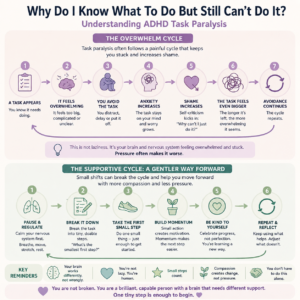
The Overwhelm Cycle
Task paralysis often follows a predictable pattern:
- A task appears.
- The task feels overwhelming.
- You avoid the task.
- Anxiety increases.
- Shame increases.
- The task feels even bigger.
- Avoidance continues.
Many people spend so much energy worrying about the task that they become exhausted before they even begin.
Over time, this can seriously impact confidence and self-esteem.
Why Pressure Often Makes Things Worse
Well-meaning advice such as:
- “Just get on with it.”
- “Stop overthinking.”
- “Just do one thing.”
often fails because it ignores what is happening internally.
For many ADHD adults, pressure increases nervous system activation.
The more pressure they feel, the more overwhelmed they become.
The more overwhelmed they become, the harder it becomes to start.
This can lead to a frustrating cycle where urgency actually reduces productivity.
What Can Help?
There is no single solution, but there are strategies that many ADHD adults find useful.
Make the Task Smaller Than You Think It Needs to Be
One of the most effective approaches is reducing the first step until it feels almost ridiculously small.
Instead of:
“Complete the application form.”
Try:
“Open the document.”
Instead of:
“Clean the kitchen.”
Try:
“Put one plate in the dishwasher.”
The goal is not to complete the task immediately.
The goal is to reduce the activation energy needed to begin.
Focus on the Next Step, Not the Whole Project
ADHD brains can become overwhelmed when trying to hold an entire project in mind.
Rather than asking:
“How do I finish this?”
Try asking:
“What is the next visible step?”
Regulate Before You Problem-Solve
Many people attempt to force themselves through overwhelm.
Often it is more effective to regulate first.
This might involve:
- Deep breathing
- Going for a short walk
- Stretching
- Listening to calming music
- Talking to a supportive person
A calmer nervous system often makes tasks feel more manageable.
Reduce Shame
Perhaps the most important intervention is recognising that task paralysis is not a character flaw.
Many ADHD adults have spent years hearing messages that they are:
- Lazy
- Disorganised
- Careless
- Not trying hard enough
These messages can become deeply internalised.
In reality, task paralysis is often the result of an overwhelmed nervous system and executive functioning difficulties, not a lack of effort.
When Therapy Can Help
Many ADHD adults seek therapy believing they need help with motivation.
What they often discover is that beneath the task paralysis lies:
- Chronic stress
- Anxiety
- Burnout
- Perfectionism
- Shame
- Fear of failure
- Rejection sensitivity
Therapy can help individuals better understand their nervous system, develop practical strategies, reduce self-criticism, and build a more compassionate relationship with themselves.
For many people, the goal is not to become perfectly organised.
The goal is to stop fighting against themselves every day.
Final Thoughts
If you regularly find yourself thinking:
“Why can’t I just do it?”
you are not alone.
Task paralysis is one of the most common and misunderstood experiences of ADHD.
The problem is rarely a lack of intelligence, effort, or motivation.
More often, it is the result of an overwhelmed nervous system trying to manage more than it can comfortably hold.
Understanding what is happening is often the first step towards breaking the cycle of overwhelm, shame, and self-blame.
And sometimes, the most helpful next step is much smaller than you think.