
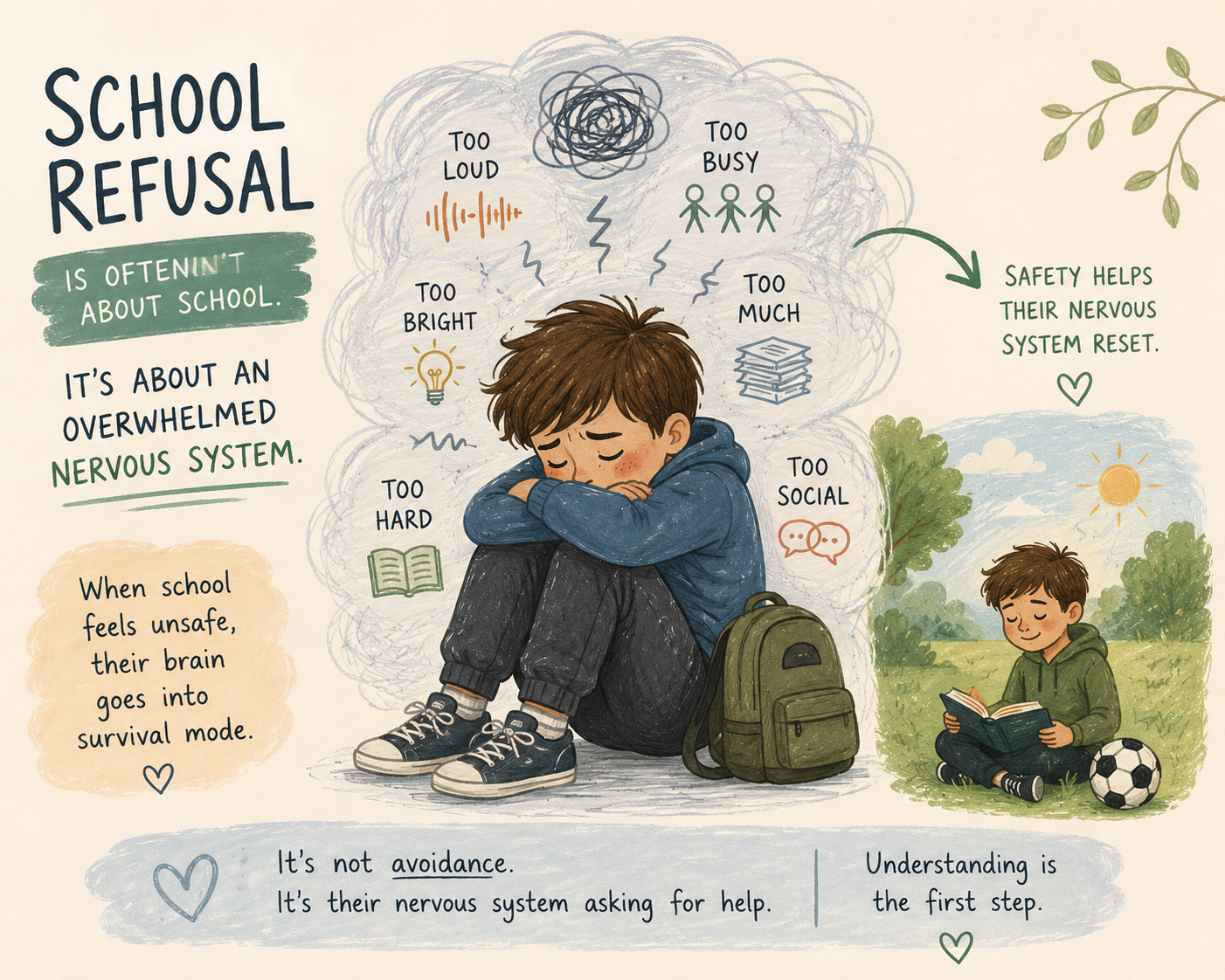
“They’re fine at the weekend.”
“If they can go to football, why can’t they go to school?”
“Maybe they’re just avoiding something they don’t want to do.”
These are comments many parents hear when their child starts refusing school.
But what if school refusal isn’t just about refusing school?
For many children, especially those who are autistic, ADHD or AuDHD, avoiding school is actually a sign that their nervous system has become overwhelmed.
In my previous blog about Emotionally Based School Avoidance (EBSA), I explored why children stop feeling emotionally safe at school. This article looks at something slightly different: the clues that tell us the problem isn’t a lack of motivation—it’s nervous system overload.
What is Nervous System Overload?
Our nervous system is constantly scanning the environment, asking one question:
“Am I safe?”
When the answer becomes “not really”, the brain gradually shifts into survival mode.
For children, this doesn’t always look like panic attacks or obvious anxiety.
Instead, it often looks like avoiding the very place that has become too overwhelming to cope with.
Here are ten signs I commonly see.
1. Mornings Become a Battleground
Your child may wake feeling sick, cry, freeze, hide under the duvet or become incredibly distressed as school approaches.
By the weekend, those symptoms often disappear.
This isn’t because they were pretending.
It’s because the threat (school) has temporarily gone away.
2. They Seem Fine at School… Until They Get Home
One of the biggest misconceptions is that if a child manages to get through the school day, they must be coping.
Many children spend every ounce of energy masking.
Then they come home and:
- explode
- cry
- withdraw completely
- become aggressive with family
- need hours alone to recover
Home is where they finally feel safe enough for their nervous system to let go.
3. Physical Symptoms Keep Appearing
Children don’t always have words for emotional overwhelm.
Instead, their bodies speak for them.
Common symptoms include:
- stomach aches
- headaches
- nausea
- dizziness
- exhaustion
- difficulty sleeping
These symptoms are very real, even when medical tests come back normal.
4. Small Demands Suddenly Feel Impossible
You might notice your child becoming overwhelmed by things that previously seemed easy.
Getting dressed.
Brushing their teeth.
Finding school shoes.
Packing a bag.
When a nervous system is overloaded, even tiny demands can feel enormous.
5. They Recover Remarkably Quickly Away From School
Parents often tell me:
“Yesterday they couldn’t even get out of bed. Today they’re laughing in the garden.”
This can feel confusing.
But it’s exactly what we’d expect if school is the source of the overwhelm.
Safety allows the nervous system to settle.
6. Their World Gets Smaller
Many children begin avoiding more than just school.
They might stop:
- seeing friends
- attending clubs
- sleeping at relatives’ houses
- going shopping
- trying new activities
Avoidance spreads because the nervous system is trying to reduce anything that feels uncertain or demanding.
7. They’re Constantly “Holding It Together”
Some children don’t melt down.
Instead, they become incredibly compliant.
Teachers describe them as:
“Quiet.”
“Well behaved.”
“No trouble at all.”
Yet those same children may be running on adrenaline for hours each day.
What looks like coping can actually be survival.
8. Punishments and Rewards Don’t Change Anything
If a child simply didn’t want to attend school, rewards might help.
But when their nervous system genuinely believes school isn’t safe, no sticker chart or consequence changes that underlying biology.
That’s why so many parents feel they’ve “tried everything.”
9. Their Confidence Starts to Disappear
Over time, children often begin saying things like:
“I’m stupid.”
“Nobody likes me.”
“I can’t do it.”
“Everyone else manages except me.”
This isn’t attention seeking.
It’s what happens when children repeatedly experience situations that overwhelm them.
10. They’re Exhausted
Perhaps the biggest sign of all.
Many children experiencing nervous system overload are simply exhausted.
They’re working incredibly hard to cope with sensory input, social demands, uncertainty, transitions, masking and anxiety.
Eventually, the body says:
“I can’t keep doing this.”
School refusal is often the point where the nervous system reaches its limit.
Looking Beyond Behaviour
One of the most helpful shifts we can make is moving away from asking:
“How do we make them go?”
Towards asking:
“What has made school feel so overwhelming?”
That question changes everything.
Instead of viewing your child as oppositional or unmotivated, we begin to understand their behaviour as communication.
Behaviour is often the language of an overwhelmed nervous system.
How Therapy Can Help
Every child’s reasons for avoiding school are different.
Some are struggling with anxiety.
Some are autistic burnout.
Some have ADHD-related overwhelm.
Others have experienced bullying, trauma or repeated experiences of feeling misunderstood.
Therapy offers a space to understand those underlying experiences rather than simply focusing on attendance.
By reducing overwhelm, supporting emotional regulation and helping children feel genuinely understood, it’s often possible to rebuild a sense of safety around learning—whether that’s in school or through a more gradual, individualised pathway.
You Are Not Failing
If your child is refusing school, it’s easy to feel judged.
Parents often tell me they worry they’re “giving in” or “making it worse.”
The truth is that understanding your child’s nervous system isn’t about lowering expectations.
It’s about recognising that children do well when they can.
When we understand what their behaviour is communicating, we’re much better placed to help them move forward.
Looking for Support?
I work with children, teenagers and parents experiencing school anxiety, emotionally based school avoidance (EBSA), autism, ADHD and trauma.
If you’re feeling stuck, overwhelmed or unsure what your child needs, you’re welcome to get in touch to discuss how therapy might help.